Understanding The M&A Process
Understanding The M&A Process
Originally published April 30, 2015 · Updated November 2026
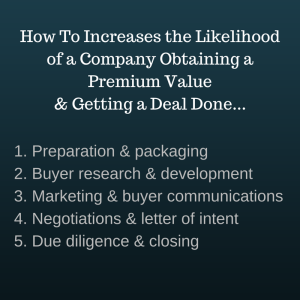
The M&A process is the series of steps a company goes through to be sold to, or merged with, another business. Selling a founder-owned middle-market company follows five phases: preparation and packaging, buyer research and development, marketing and buyer communications, negotiations and letter of intent, and due diligence and closing. Run in that order by an experienced advisor, they create a competitive market of informed buyers, which improves a founder's chances of a premium price and a deal that closes.
Most owners sell a business once or twice in their lives. The private equity funds and large corporations on the other side of the table have teams who buy and invest for a living, and they know how to shape deal terms in their favor. A disciplined sell-side process closes that gap. It presents your company to multiple pre-qualified, informed buyers and asks each of them for an offer. We first set out these five phases here in 2015, and they still frame how we run a sale today.
What are the five phases of selling a business?
1. Preparation and packaging. The advisor learns the business the way a buyer will see it, normalizes the financials, sets a realistic value range, and writes the materials buyers read first.
2. Buyer research and development. Owners often picture their buyers as partners, employees, competitors, key customers, major suppliers, or local investors. Those are all valid options, but the real universe is much larger: public and private companies in the US and abroad (strategic buyers), and private equity firms and family offices that buy companies as investments (financial buyers). The challenge is rarely finding a buyer. It's finding the right one, and you have very likely never met them. In a partial sale, that investor also becomes your partner for years, so how they work with founders matters as much as price.
3. Marketing and buyer communications. Qualified buyers receive a blind summary first, sign a non-disclosure agreement, and only then see the full information. That keeps the sale confidential. Deadlines then keep buyers moving in parallel and bidding against each other.
4. Negotiations and letter of intent. Offers are compared on more than headline price: structure, cash at close, financing certainty, and the buyer's plans for your team. The chosen buyer signs a letter of intent, which usually grants exclusivity.
5. Due diligence and closing. The buyer confirms everything it was told while lawyers draft the purchase agreement. Good preparation in Phase 1 helps keep this phase on schedule and protect the price. Our due diligence tips for sellers cover how to get ready.
Running all five phases well takes a lot of work, energy, and skill. An experienced M&A advisor manages the process so you can keep running your business, and helps you choose a buyer or investor based on both your business goals and your personal ones. Your main part is giving your advisor complete, accurate information early and keeping the business performing while the sale runs. Our full guide sets out what you'll be asked for in each phase.
The full step-by-step guide
Each phase has many steps of its own. For what happens in each one, what your advisor does, what you'll be asked to do, and how long it usually takes, read our full guide: The Sell-Side M&A Process for Founder-Owned Businesses: Step-by-Step Guide [LINK: add the guide's URL once it's live].
More from Founders Advisors:
-
Our transactions: companies we've advised on sales and recapitalizations
Questions about the M&A process
Do I need an M&A advisor to sell my business?
You don't have to use one. Without an advisor, though, you're usually negotiating with one buyer at a time, against a team that buys companies for a living.
Where should I start if I'm thinking about selling?
Start by finding out how ready your business is. Our Investment Grade Assessment asks over 90 targeted questions across 12 sections and gives you a customized report on your company's investability, marketability, and growth strategy.
When you're ready to talk it through, contact Founders Advisors, or read how our sell-side advisory works.
About Founders Advisors
At Founders Advisors, we advise founder-owned and family-owned middle-market companies on mergers and acquisitions. Duane Donner started the firm in 2003, and Founders Investment Banking became Founders Advisors in 2017. Today more than fifty professionals help owners sell their businesses, make acquisitions, and raise capital, with deep sector expertise in Business Services, Consumer, Healthcare, Industrials, and Technology. We work through the Founders Advisor Framework, and every relationship starts with listening. We're not deal-chasers. We're legacy stewards. Learn more about Founders Advisors.
In order to provide securities-related services discussed herein, certain principals of Founders Advisors, LLC are licensed with M&A Securities Group, Inc. or Founders M&A Advisory, LLC, both members FINRA and SIPC. M&A Securities Group and Founders are unaffiliated entities. Founders M&A Advisory, LLC is a wholly-owned subsidiary of Founders Advisors, LLC. Neither Founders M&A Advisory, LLC nor Founders Advisors, LLC provide investment advice.